Planning
·
2026
When scenario planning helps—and when it becomes theater
Scenario work can be done in two ways.
First, it can be a disciplined way to improve decisions under uncertainty: You use alternative futures to test whether your plan is robust, to identify what would break it, and to determine what you must watch so that you can move early rather than late.
Alternatively, it can be a performative exercise: You generate elegant narratives, give them clever names, debate them like short stories, and then return to the same plan you walked in with—just with better slides.
Both forms can look professional. Both can use sophisticated language. Talented people can run both. Only one, however, changes behavior.
Fill in the details and get access to the full article.
Scenario theater: What it is and how leaders recognize it
Scenario theater substitutes narrative sophistication for decision discipline. It produces plausible futures without specifying what must be believed, monitored, or done differently, resulting in preparedness as performance rather than as capability.
Leaders recognize it quickly because of its distinct feel. Here are three indicators that show up time and again.
The narratives are memorable, the decisions are unchanged.
After the workshop, everyone can describe the “four futures” and the clever axes. But ask what the organization will do differently next week—what will stop, what will start, what will be reallocated, what will be delayed—and the answer is vague. The exercise produced language, not choices.There are no triggers, so nothing can force a rethink.
Teams talk about how they will “monitor the environment,” but they do not define thresholds that would trigger a decision review. Without thresholds, monitoring is just observation. It feels responsible and produces updates, but it does not create a requirement to act.No one owns the signposts, so the work dissolves into general awareness.
The outputs live in a deck or a binder. There is no named owner for each indicator, no established review cadence, and no mechanism to link a changed condition to an authorized change in posture. In practice, “we’ll keep an eye on it” means “no one is accountable.”
If you recognize these indicators, you do not have scenario planning; you have a well-run meeting.
4 conditions when scenario planning is worthwhile
Scenario planning is not a default activity. It is worth carrying out when it serves a specific purpose, and when the organization is prepared to treat the outputs as operational commitments. Scenario planning earns its keep under four conditions.
1) Contested frames: The leadership team does not agree on what world it’s in
If senior leaders hold competing interpretations of the environment—what is changing, what is stable, and what matters most—then scenario planning can help by making these disagreements explicit and testable. The goal is not to force consensus through storytelling; it is to surface different causal beliefs and stress test them.
Under this condition, scenario work is useful because it creates a structured way to say: “If your view is right, what would we expect to see? If mine is right, what would we expect to see?” That turns conflict into evidence rather than politics.
2) Real uncertainty: The variables that matter cannot be forecast with confidence
If the central drivers of your decision are not forecastable with acceptable accuracy—regulatory posture, competitor moves, customer procurement behavior, geopolitical access, capital costs—then scenarios provide a way to reason without pretending you can predict.
The value is not a prediction; it is identifying which assumptions are doing the most work in your plan, and what would make those assumptions unsafe.
3) Irreversible or expensive commitments: The cost of being wrong is high
Scenario work matters when you are about to make commitments that are difficult to unwind, such as entering a market, acquiring a company, building a capability, committing to a platform migration, redesigning an operating model, reshaping a portfolio, or signing a long-term partner agreement.
If the decision can be reversed cheaply, you often do not need scenarios; you need experimentation. However, when reversal is costly, scenario work is a disciplined way to mitigate fragility before committing.
4) Adversarial environments and timing decisions: When others react and timing matters as much as direction
Scenarios are particularly valuable when outcomes depend on how other actors adapt to your moves—competitors, regulators, counterparties, or geopolitical stakeholders—or when the central uncertainty is not what to do, but when to do it. Questions such as “Do we move now, wait, or stage the move?” are rarely resolved by analysis alone, yet they are where strategic risk accumulates.
Timing is also where drift hides. Leadership teams often agree on the long-term direction, but fail to specify the conditions under which they will accelerate, pause, sequence differently, or pivot. Absent those conditions, the organization defaults to inertia while believing it has a strategy.
In adversarial settings, scenarios expose second-order effects: How others are likely to respond, how those responses reshape your option set, and where your plan becomes fragile under pressure.
Why theater happens: Incentives, comfort, and the absence of a decision spine
Scenario theater is not a moral failure; it is an incentive problem and a method problem. Here are some of the factors that make scenario planning a failing strategic instrument.
Alignment incentives. Many organizations reward visible alignment more than well-handled explicit disagreement. A scenario workshop can create the appearance of alignment—everyone nodding in agreement with the narratives—without forcing anyone to confront the hard trade-offs that would reveal real differences.
Facilitation bias. Facilitators are often incentivized to maintain positive energy, keep everyone engaged, and produce a polished artifact. That can subtly steer the group away from conflict and toward the story. The more elegant the narrative, the easier it is to avoid the hard question: “So what are we going to do differently?”
Story comfort. Humans like stories. Stories reduce anxiety, because they make us feel like we understand. Under uncertainty, the story is soothing; it gives shape to ambiguity. But strategy is not therapy, and comfort is not the point.
Avoiding real conflict. The decisions that matter most under uncertainty invariably involve hard trade-offs—risk tolerance, capital allocation, reputational exposure, organizational focus, and timing. Scenario theater provides a way to acknowledge these tensions rhetorically without resolving them. The conversation feels substantive, but the underlying conflicts are deferred rather than decided.
No decision spine. This is the technical failure at the core of scenario theater. When scenarios are not anchored to a specific decision, they have nothing to organize around. They are presented as “informative,” but without an explicit choice to improve, the exercise has no spine. The work floats—imaginative, coherent, and ultimately disconnected from judgment and action.
Decision-first approach: Use scenarios to stress test, not to decorate
If you want scenario planning that actually matters, invert the usual sequence.
Most scenario workshops start with, “Let’s imagine futures.” That is backward. Start with, “What decision are we trying to improve?” Then work outward.
Here is a pragmatic, decision-first method. It is not complicated; it is disciplined.
Step 1: Define the decision and posture options
Deliverables: decision statement; 2-4 posture options; decision horizon
Write the decision in one sentence.
Define the time horizon during which the decision is expected to hold.
Specify a small number of posture options you could plausibly take (e.g., “enter now,” “stage entry,” “partner first,” “pause and build capability,” “exit,” “double down”).
If you cannot articulate the posture options, you are not doing scenario planning; you are doing a general reflection.
Step 2: Make the load-bearing assumptions explicit
Deliverables: assumption register (10-20 max); “critical few” assumptions (3-6)
List the assumptions that must be true for the preferred posture to succeed. But do not include every belief, only the load-bearing ones. If an assumption being wrong would not change the decision, it is not a load-bearing one.
Then identify the “critical few”: The assumptions that, if false, would break the plan or make it irresponsible.
Step 3: Use scenarios to stress test assumptions and expose second-order effects
Deliverables: 3–4 stress scenarios; assumption impact notes; second-order risk map
Develop a limited set of scenarios designed to test critical assumptions rather than cover every imaginable future scenario.
This is where discipline matters. Scenarios are not a creativity contest; they are stress rigs. Each scenario should be built to answer, “What changes in this world would make our key assumptions unsafe, and what would that do to our posture?”
Include second-order thinking: How competitors respond, how customers adapt, how internal constraints surface.
Step 4: Define indicators, thresholds, and triggers
Deliverables: indicator list per critical assumption; threshold definitions; trigger events; “review if/then” rules
For each critical assumption, define:
Indicators (signposts): What will you watch?
Thresholds: What level of change matters?
Triggers: What specific events or values force a decision review?
If you skip thresholds, you are back in the theater. Monitoring without thresholds is a slow-motion excuse for inaction.
Step 5: Assign ownership and monitoring cadence
Deliverables: owner per indicator; monitoring cadence; escalation path
Each indicator needs an owner: a person accountable for making sure the signal is tracked and reported in a useful form, not a committee.
Set a cadence: monthly, quarterly, or event-driven—whatever aligns with the decision horizon and the pace of change. Define what happens when a trigger is hit: Who convenes, what decision is revisited, and what authority exists to change posture.
Step 6: Record the decision logic
Deliverables: decision record (one page); rationale; what would change the decision
Create a concise decision record that captures the following key elements: the decision, the chosen posture, the critical assumptions, the triggers, and the review cadence.
This is the piece that makes you smarter under pressure. Months later, when people argue about “what we thought at the time,” you will have the logic.
Mini-case vignette: From theater to decision discipline
Here is a fictional, yet realistic, example.
A mid-sized industrial technology company—let's call it Northbridge—conducts a two-day scenario exercise. The market is volatile. Supply chains are unstable. A competitor has begun offering aggressive service contracts bundled with equipment. Northbridge’s CEO wants to “get ahead of uncertainty.”
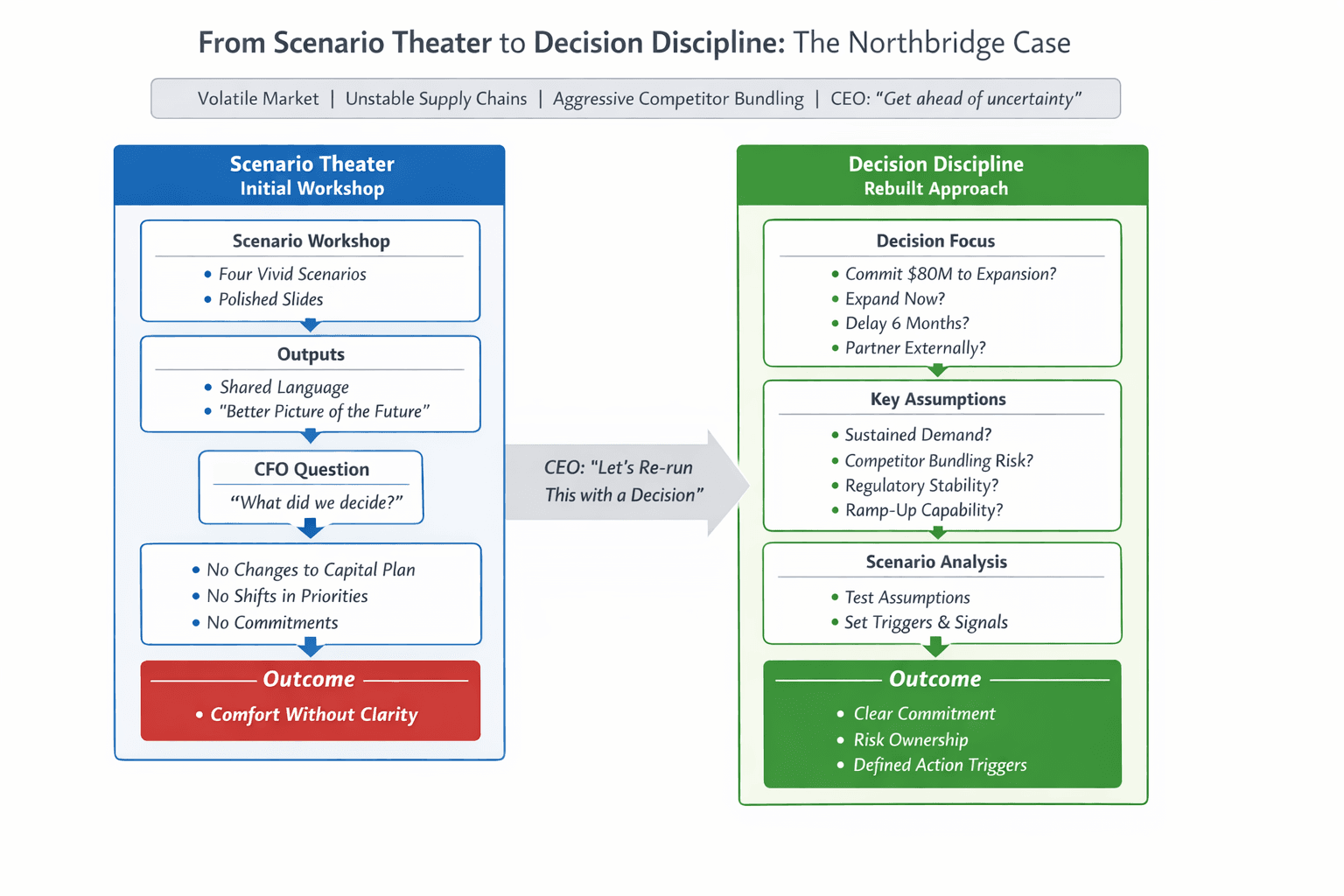
The first workshop is classic theater: The team produces four scenarios with evocative names. The deck is strong. Everyone agrees the future is uncertain. People leave feeling energized.
Two weeks later, the CFO asks a blunt question: “What did we decide?” Silence. The COO says, “We have a better shared picture.” The head of sales says, “We know what to watch.” But nothing changed. The capital plan stayed the same. Product priorities stayed the same. Pricing stayed the same. The organization bought comfort, not clarity.
The CEO decides to rerun the work, but in a different way.
They start with a decision to make: whether to commit $80 million to expand a manufacturing line now, delay for six months, or partner with a contract manufacturer. The decision horizon is 18 months; irreversible enough to matter.
They list posture options and then build an assumption register. Four assumptions emerge as critical:
Demand in the target segment will sustain at a level that justifies the expansion.
The competitor’s bundling strategy will not lock up key accounts before Northbridge can respond.
Regulatory and trade conditions will not introduce new import constraints on a key component.
Northbridge can rapidly ramp up labor and maintenance capabilities to meet yield targets.
They then build three stress scenarios, each designed to break one of those assumptions. One scenario models rapid competitor lock-in. Another is a trade constraint hitting the key component. The third models demand volatility combined with labor scarcity.
Now the work becomes operational. For each assumption, the team defines indicators, thresholds, and triggers to monitor progress. For example, competitor lock-in is tracked through account-level signals, including contract lengths, renewal terms, and specific features bundled. The trigger is explicit: If a defined percentage of the top accounts sign multiyear bundles, the expansion decision is revisited within 10 business days.
Ownership is assigned. Sales owns the account signals. Supply chain owns trade and component availability signals. Operations owns labor ramp indicators. The CFO owns the review cadence and convenes the trigger review.
The outcome is not that uncertainty disappears; it is that the company stops pretending that scenarios are “the strategy,” and instead treats them as a tool to tighten decision logic. Northbridge still takes risks, but it takes them with defined tripwires.
That is the shift from theater to decision discipline, from stories to obligations.
Conclusion: Use scenarios without overpromising prediction
Scenario planning should not be sold as a prediction, and leaders should not tolerate it as a performance measure. Used well, scenarios are a structured way to say: “We are committing uncertainty. Here is what must be true. Here is what we will watch. Here is what will force us to change posture. Here is who owns that responsibility.”
That is neither glamorous nor poetic. It is, however, what preparedness looks like in an environment that does not care how good your slides are.
Checklist: If you’re about to run a scenario exercise, ask these questions
What decision are we trying to improve, specifically, and by when?
What commitments (capital, posture, capability) are on the line if we get it wrong?
What are the 3–6 assumptions doing the most work in our preferred plan?
What would we have to observe to conclude that those assumptions are unsafe?
What indicators will we monitor, and what thresholds will trigger a review of the decision?
Who owns each indicator, and what is the monitoring cadence?
What will we do differently next week as a result of this exercise—stop, start, reallocate, delay?
If you cannot answer these questions before you schedule the workshop, you are likely organizing a theater. And you probably already know it.