Strategy
·
2026
Why strategy breaks under uncertainty: Old frames in a discontinuous world
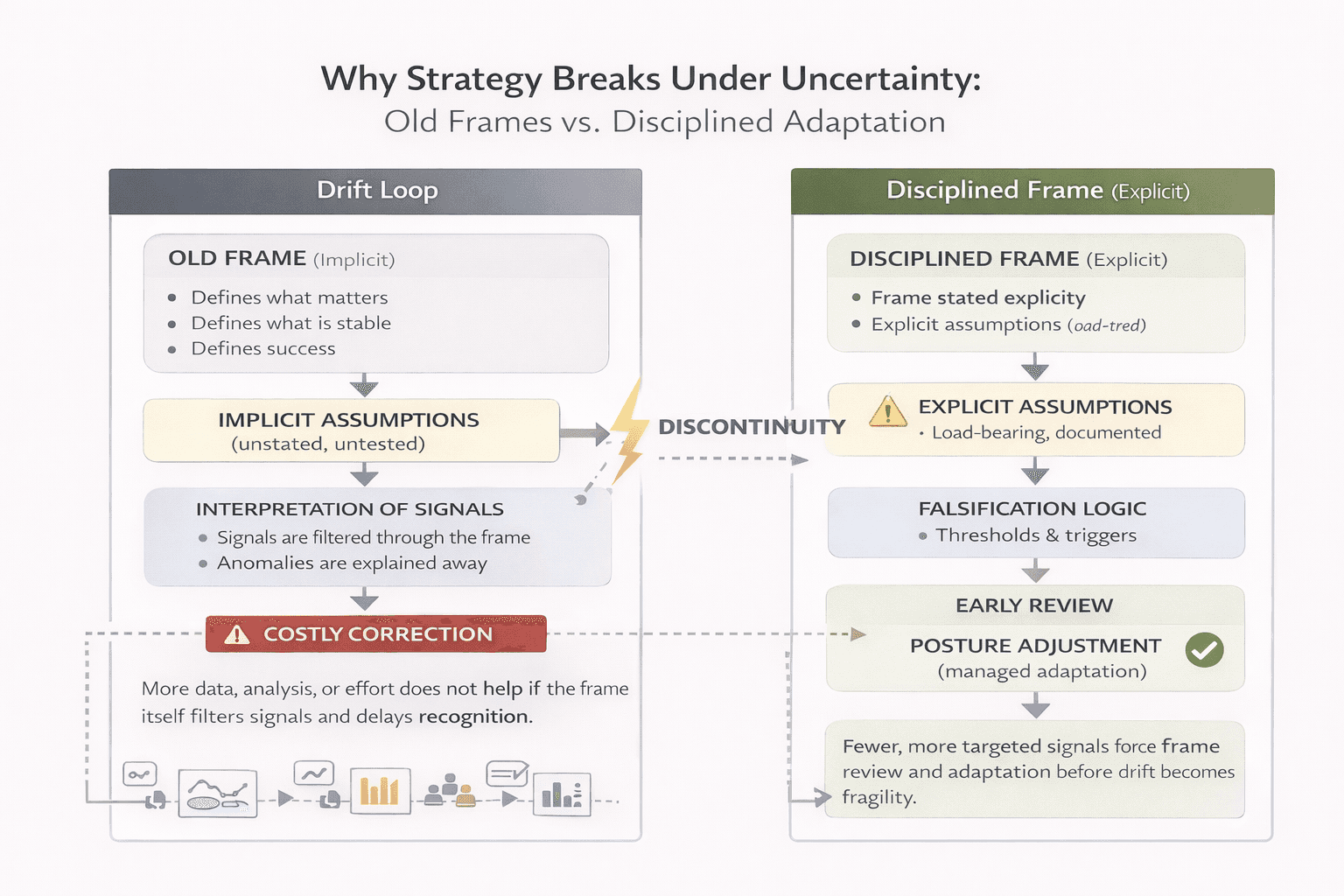
Strategy breaks earlier than leaders would like to admit. It rarely happens at the point of analysis, but often at the point of framing. The failure pattern is consistent: inadequate framing → implicit assumptions → drift. A team adopts a way to define a situation that frames a set of beliefs about what will remain stable, but execution continues even after those beliefs become unreliable. By the time the organization acknowledges what has changed, it has already made commitments that are expensive to reverse.
This is not a story about careless executives or lazy planning. Most leadership teams work hard, read widely, and have access to more information than previous generations could have imagined. Yet strategy still fails—often in organizations with strong people and strong data—because they are reasoning within a conceptual map that no longer matches the terrain.
Fill in the details and get access to the full article.
Strategy often fails when choices are framed
The earliest, most consequential decisions in strategy are not calculations; they are the choices people make about what they consider the relevant decision environment, which forces matter, what time horizon is relevant, and what “success” means in this context.
Those are framing choices. They often happen quickly, in the first few meetings, and then disappear. The organization transitions from “what world are we in?” to “what should we do?”, without explicitly articulating the beliefs connecting the two. You can get away with that under stable conditions, since the world tends to forgive such a disconnect. However when there is a discontinuity, a mismatch becomes the main risk.
What “discontinuous” means in practice
A discontinuous environment is one in which the rules for orienting yourself stop being reliable. It is not because “things are changing,” because things are always changing. It is when the baseline breaks: The patterns you relied on no longer are repeated, the relationships between actions and outcomes shift, and the range of plausible futures widens sharply.
In practical terms, here are several ways to identify discontinuity:
Shifting regimes: The operating context changes in a way that is not a short-term fluctuation but a permanent change—such as a new regulatory posture, a new enforcement behavior, a new security reality, a new cost structure, or a new constraint.
Non-linear change: Small events produce outsized effects, and familiar efforts yield diminishing returns. The old levers still move, but not as much as before.
Broken baselines: Metrics that used to mean something stop being interpretable because the underlying conditions — customer behavior, distribution, procurement cycles, or risk tolerance — change.
Policy shocks: New rules, tariffs, approvals, restrictions, or standards reset timelines and economics.
Adversarial adaptation: Competitors, counterparties, or other actors adjust specifically in response to your actions, making yesterday’s playbook self-defeating.
The key point is not that these dynamics exist but that they are not acknowledged and that they invalidate quite a few assumptions, especially that the future will behave like a variation of the past.
Why standard strategy tools degrade under discontinuity
Many standard strategy practices rely, at least implicitly, on three beliefs: key variables are reasonably stable, cause and effect are primarily linear, and the environment’s underlying behavior does not change faster than your ability to plan. Leaders rarely admit this out loud, but it is implicit in how planning cycles, forecasts, and dashboards are used.
When those beliefs cease to hold, three predictable problems follow:
More precision with less relevance. Teams build more detailed models, more granular forecasts, and more elaborate plans. Even though the work is technically competent, if the frame is wrong, the analysis becomes a precision instrument applied to the wrong question.
Leadership debate becomes a contest of narratives. In times of ambiguity, people often reach out for a familiar story: “this is a temporary dip,” “this is a new era,” “this is just a competitor tactic,” or “this is a customer behavior shift.” Without explicit assumptions, those stories become rhetoric rather than testable propositions. And then decisions are made by seniority, by volume, or by fatigue—not by evidence.
Motion is mistaken for progress. Workstreams multiply; task forces appear; reporting expands; the organization feels responsive. But the logic that connects evidence to taking a stance—what must be true for the strategy to remain valid and what would force a change—remains vague. The strategy becomes a set of activities that feels purposeful but is no longer anchored to an explicit definition of what is being decided.
Once the frame is set, assumptions quietly accumulate. They are rarely written down because they seem “obvious,” and they are rarely questioned because doing so appears to cast doubt on the plan itself.
When new signals arrive, leaders interpret them through their preferred narrative. Since assumptions are implicit, the organization lacks a shared standard for what constitutes decisive evidence. Meetings often devolve into debates about interpretation rather than discussions about definitive thresholds. Meanwhile, execution continues because stopping feels uncomfortable and irresponsible. Over time, the organization begins to treat momentum as a form of intent: “We’re already in motion, so we might as well continue.”
Eventually, there is delayed recognition. The organization concedes that the environment has changed, but is still reacting from within a set of commitments—hiring, product direction, contracts, partnerships, and capital allocations—made under the old framework. The need for urgent correction in strategy becomes abrupt and painful, not because leaders lacked intelligence, but because they lacked a disciplined way to notice earlier that the map was wrong.
A better approach: Decision clarity, explicit assumptions, and falsification logic
In discontinuous conditions, the goal is not to eliminate uncertainty; it is to reduce fragility. That requires a different standard of discipline:
Decision clarity: What is being chosen now? What is being deferred? What time horizon is the choice supposed to cover?
Explicit assumptions: The few beliefs that must be true for the decision to remain sound
Falsification logic: What evidence would make those assumptions unsafe to rely on?
Thresholds and triggers: The specific signals, levels, and time windows that force a review
Ownership: Clear accountability for monitoring the decisive signals, and a call for realignment with the new emerging reality when thresholds are crossed
This is not a new framework; it’s basic decision hygiene made explicit because the environment is no longer forgiving.
Example: One decision, four assumptions, and what would change your mind
Consider the following decision that many leadership teams face:
Leadership decision: “We will enter Market B in the next 12 months by acquiring a smaller competitor, and by using our existing platform as the base.”
On the surface, this appears to be a straightforward growth move. Underneath, it depends on a set of assumptions that often remains unspoken. Here are four assumptions and what would disprove them.
Assumption: The regulatory environment will allow the acquisition to close and to operate in accordance with the planned timeline.
What would falsify it: Credible signals of delayed approvals beyond an agreed window (e.g., those trending past a defined quarter), or new compliance requirements that materially change integration cost and time to market.Assumption: The acquired company’s customers will remain loyal through the integration process.
What would falsify it: Post-announcement churn indicators above a defined threshold, a pattern of contract renegotiations signaling flight risk, or a measurable decline in renewal intent within a specific segment that underpins the deal’s economics.Assumption: Our existing platform can meet Market B requirements with manageable modifications.
What would falsify it: Due diligence findings that key requirements need architectural change rather than configuration, or pilot results showing those performance, security, or workflow gaps that cannot be closed within the planned integration window.Assumption: Competitors will not change the basis of competition during our entry window.
What would falsify it: Competitor move that shifts customer expectations in a structural way—exclusive distribution, bundling that locks buyers, pricing model change that reshapes budgets, or partnership that blocks access to critical channels.
The value of this exercise lies not in predicting the future, but in clarifying what the decision is really betting on, and in forcing agreement on what would change the team’s mind. This is what prevents drift. Without this, warning signs get absorbed as “manageable challenges” until the organization is trapped by its own momentum.
Conclusion: The practical promise
A strategy designed this way delivers a simple promise: fewer fragile commitments, faster course correction, and a more coherent leadership discussion when the environment stops cooperating.
You cannot control discontinuity, but you can control whether your organization drifts within an outdated frame. The difference is whether you make the load-bearing assumptions explicit and treat them as part of the strategy rather than as private intuitions held by individual executives.
Practical, 5-step method for effective framing
Write the decision in one sentence.
What are you committing and not committing to? How long is the decision intended to hold?State the frame explicitly.
Clearly describe the environment you believe you are in: What has changed? What is unstable? What are you treating as the current rules of the game?Name the load-bearing assumptions.
Identify the small set of beliefs that must be true for the decision to remain sound. If a wrong assumption does not change the decision, it is not a load-bearing one.Define falsifiers, thresholds, and triggers.
For each assumption, specify what you would have to observe to conclude it is no longer safe. Set thresholds that force review—dates, deltas, levels—so you do not debate endlessly when evidence arrives.Assign ownership and cadence.
Determine who monitors which signals, how frequently they are reviewed, and what actions are taken when a threshold is exceeded. The goal is not more reporting; it is earlier, cleaner posture changes.
If this describes what occurs in your organization, it is time to hold a strategic conversation.