Decision Governnace
·
2026
Strategic surprise is often a result of framing failure
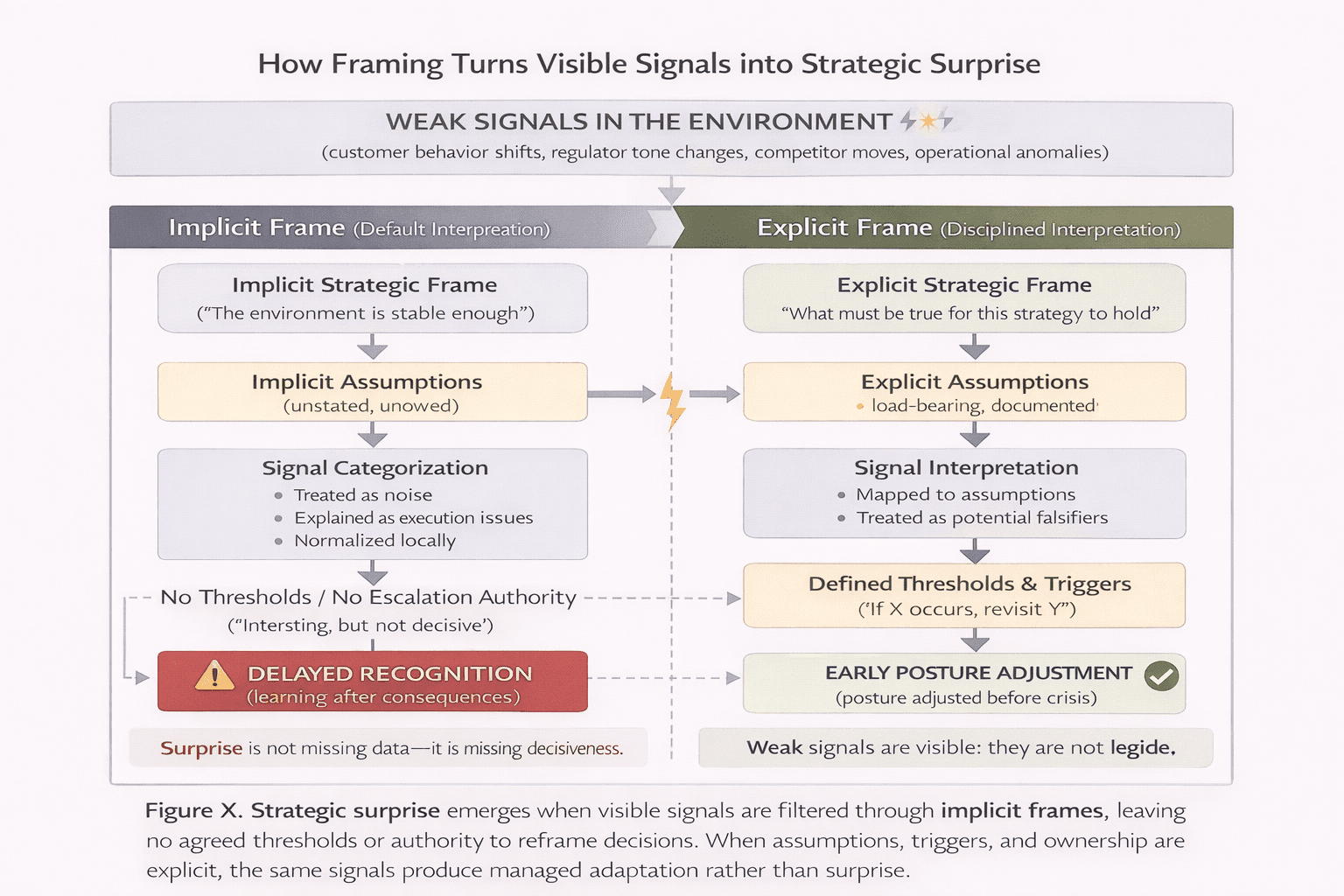
Most organizations describe strategic surprise as an intelligence failure: “We didn’t know,” “No one could have predicted,” “It came out of nowhere.” In my experience, that explanation is usually wrong—or at least incomplete. In many cases, the weak signals were visible. What failed was the frame that determines whether those signals are perceived as meaningful, who feels responsible for escalating them, and what the organization is prepared to do if an assumption starts to break.
A total lack of information rarely causes surprise. The way information is interpreted and filtered through prevailing narratives, incentives, and decision forums, however, is a cause. When assumptions are implicit, teams can explain away disconfirming evidence indefinitely. When ownership for reassessment is vague, no one has the mandate to say, “This changes the posture.” And when there is no disciplined mechanism for updating judgment, the organization learns only after there are consequences.
This piece argues that reducing surprise is not a forecasting trick. It is an organizational capability: a set of practices that makes assumptions explicit, defines what would falsify them, assigns responsibility for monitoring, and preserves decision rationale in a way that can be revisited under pressure. The objective is not to eliminate uncertainty. It is to prevent the organization from being surprised by what it could have recognized earlier—if it had been reasoning within a better framework.
Fill in the details and get access to the full article.
Provocation: Surprise is rarely “no one could have known”
If you listen closely to post-mortems after a surprise, the language is almost always defensive. People reach for absolution: “Nobody saw it.” “We had no way to know.” “The data wasn’t there.”
Sometimes that is true. But most of the time it is an institutional story that protects the existing way of operating. It implies that the organization was unlucky rather than misframed. It suggests that the solution lies in gathering more data, implementing more monitoring, and utilizing more intelligence rather than focusing on better questions, explicit assumptions, clearer triggers, and more transparent decision-making forums.
The harder truth is that many surprises are predictable in retrospect, because the signals were present. They were simply discounted, normalized, or interpreted as irrelevant; not because individuals were foolish, but because the organization’s frame made those signals easy to ignore.
The practical implication is uncomfortable. If surprise is usually a framing failure, then reducing surprise requires leaders to change how their organization reasons and not just what it knows.
Three types of surprise—and how framing fails in each
Not all surprises are the same. Lumping them together hides the mechanics. It is useful to distinguish between three types of surprise – tactical, operational, and strategic surprise. Each has a different failure pattern, and each requires a different corrective emphasis.
1) Tactical surprise: “We did not see the move in time”
Tactical surprise is about immediate action: an unexpected competitor launch, a sudden customer defection, a regulatory enforcement action that hits without warning, a cyber incident, a negative press cycle that accelerates.
How framing fails tactically: The organization frames the situation as stable enough to manage through routine monitoring. It assumes that the next move will resemble the last move. It treats short-term anomalies as noise. Tactical signals get handled as “issues” rather than as possible indicators of a changing play.
Tactical surprise often happens when leaders confuse awareness with readiness. They have dashboards, they have updates, they have “visibility.” However, they lack agreed-upon triggers for escalation and a forum designed for rapid posture changes. They see the move, however, they cannot decide quickly enough because their decision-making frame is built for normal operations.
2) Operational surprise: “We didn’t expect the system to behave this way”
Operational surprise is primarily about the internal system, including supply chain breakdowns, failed integrations, capacity constraints, sudden quality issues, unanticipated labor shortages, and a program that slips because dependencies were not properly understood.
How framing fails operationally: The organization frames complexity as being controllable through planning. It assumes that dependencies are known, that the system behaves linearly, and that risk can be managed by adding buffers rather than by rethinking architecture. Operational teams see weak signals early—small defects, near misses, recurring exceptions—but they are normalized as “part of execution.”
Operational surprise thrives in organizations that treat “delivery” as the primary virtue. People learn to explain away early warnings, because raising them is interpreted as obstructing momentum. The frame is to keep the plan moving and manage problems locally. In that frame, escalation is culturally expensive until it becomes unavoidable.
3) Strategic surprise: “The environment changed, and our posture was wrong”
Strategic surprise is the most damaging of the three types. It is when the organization’s broader assumptions about the environment break: a market regime shifts, a regulator’s posture changes, a competitor changes the basis of competition, customer behavior reanchors, capital or input constraints harden, or a geopolitical condition reshapes access.
How framing fails strategically: The organization frames the environment using yesterday’s baseline. It assumes continuity. It treats disconfirming signals as temporary disturbances. It explains away anomalies, because acknowledging them would force a reconsideration of commitments that are already underway.
Strategic surprise is often not about missing information; it is about failing to treat information as decisive. Leaders do not define what must be true for the strategy to remain valid, so there is no agreed mechanism for “This changes the posture.” The organization drifts until there are consequences.
Root causes: Wrong questions, implicit assumptions, and organizational seams
If surprise is usually a framing failure, then what are the root causes? They are consistent across industries.
Wrong questions. Organizations ask questions that are comfortable rather than diagnostic. For example, they ask “How are we performing?” instead of “What would make this strategy invalid?,” “What is the forecast?” instead of “What assumptions are we betting on?,” “What are the risks?” instead of “What would change our mind?”
Implicit assumptions. Assumptions remain as private intuition rather than as shared commitments. When assumptions are not written down, they cannot be monitored, challenged, or falsified. They become invisible load-bearing beams. When one breaks, the organization acts surprised.
Incentives to explain away weak signals. Weak signals create friction. They slow the momentum. They introduce ambiguity. Many organizations reward smooth progress more than they reward early recognition. People learn to minimize anomalies until they become undeniable.
Fragmented responsibility across seams. Most strategic surprises cross boundaries: sales sees a pattern, but operations doesn’t; compliance senses a shift, but product doesn’t; customer success hears things that strategy never hears. If no one owns “What this means for posture,” seams become blind spots. Everyone has a piece of the picture; no one has the mandate to reframe the whole.
Intelligence feeds do not solve these root causes. They are solved only by better decision design and assumption discipline.
Surprise mechanics: weak signals are visible, but not legible inside the prevailing narrative
Here is the core mechanism, stated plainly: Organizations miss what does not fit their narrative.
Data does not speak for itself; it is interpreted. Signals are not inherently “weak” or “strong.” They become weak when they conflict with what the organization expects to be true, and when there is no agreed frame for treating them as meaningful.
The organization’s narrative acts like a filter, with which:
Signals that confirm the narrative are amplified.
Signals that conflict are discounted as noise, outliers, or “one-offs.”
Signals that threaten commitments are treated as execution problems rather than as assumption problems.
This is why surprise often feels sudden even when it has a long prehistory. The organization has been accumulating disconfirming evidence, but it has been categorizing it in a way that prevents it from becoming decisive.
The weak signal was not invisible. It was unintelligible
This is the sentence leaders should consider.
Most weak signals are visible to someone. A salesperson hears customers shifting language. A mid-level manager notices that exceptions are becoming normal. A policy analyst notices a shift in the enforcement tone. A competitor intelligence lead sees unusual hiring patterns. A security team sees probing activity.
The problem is not that no one saw it; it is that the organization lacked a shared interpretive frame that made the signal legible as “this matters.” It was unintelligible in the prevailing story.
Even worse, in many organizations, the people closest to weak signals do not feel authorized to say, “This changes the posture.” Their job is to handle issues, not to reframe strategy. So the weak signal remains local knowledge until it becomes a visible outcome.
Reducing surprise means making weak signals intelligible by connecting them to explicit assumptions and explicit triggers.
Disciplined prevention: the practices that reduce surprise
Reducing surprise is not about building a perfect early warning system. It is about building an organization that can recognize when its assumptions are being broken, and can change its posture before the consequences force it to do so.
A disciplined approach includes six elements.
1) Assumption tracking: Name the load-bearing beliefs
For every major strategic commitment—such as market entry, platform shift, acquisition, or operating model change—leaders should identify the small number of assumptions that must hold true for the strategy to remain sound. If you cannot state those assumptions, you are not managing uncertainty; you are hoping.
2) Signposts and indicators: Decide what you will watch
Assumptions must be tied to monitorable indicators. “We’ll keep an eye on it” is not a method. An indicator is specific to things like customer contract terms, regulator language, supplier lead times, competitor hiring, churn patterns, defect rates, pipeline conversion rates, and procurement cycle lengths.
3) Thresholds: Define what would count as meaningful change
Indicators without thresholds are just reporting. Thresholds define the level at which a change becomes decision-relevant, converting observation into obligation.
4) “What would change our mind?”: Make posture change explicit
Leaders should be able to answer in a sentence: “If we observe X, we will revisit Y.” This is not a weakness; it is strategic maturity, and it creates a shared standard for when the organization must reconsider its course.
5) Decision forum design: Ensure there is a place to change posture
Most organizations hold numerous meetings for updates, but have far fewer forums for genuine change in posture. If a trigger is hit, where does the organization decide what it means? Who is in the room? What authority exists? Without a posture change forum, triggers will be discussed and deferred until the situation forces action.
6) After-action learning loop: Learn in a reusable way
Every surprise should result in a short learning loop: What assumptions failed, what signals were present, what prevented escalation, what decision forum failed, and what changes need to be made. The goal is not blame; it is organizational learning that improves future framing.
These practices are not complex. They are uncommon, because they require leaders to treat uncertainty as a governance problem rather than as a forecasting problem.
The Surprise Log tool
The simplest tool I know for reducing surprise is a Surprise Log. It is not a dashboard or a report. It is a disciplined record of “things that did not fit our expectations,” and what they imply about the organization’s assumptions.
A Surprise Log does two things at once:
It creates an institutional memory of anomalies rather than letting them evaporate.
It forces leaders to connect anomalies to assumptions and decisions.
Surprise Log fields (simple and repeatable)
Each entry should include:
Date observed
What happened (one sentence)
Why it surprised us (what expectation it violated)
What assumption might be failing
What signal preceded it (if any)
What we explained away at the time (if applicable)
What is the potential impact if the assumption is broken
What indicator should be monitored going forward
Threshold/trigger for escalation
Owner (named person)
Next review date
Status (open / monitoring / closed)
The log is lightweight enough to run in any organization. Its power is not the form, but the discipline of connecting surprise to assumption and ownership.
Monthly review cadence (how it runs)
Once a month—no more, no less—run a 45–60 minute Surprise Review with a small group of accountable leaders based on the following agenda:
Review new Surprise Log entries (10–15 minutes)
For each entry, decide: Is this noise, or a signpost? (15 minutes)
If signpost, assign indicators, thresholds, and owners (15 minutes)
Review previously open entries: Did the indicator move? Did thresholds trigger? What action is required? (10–15 minutes)
Capture any required posture review as an explicit follow-on meeting, not as “we’ll discuss later.”
The review is not therapy; it is decision hygiene, training leaders to treat anomalies as input to framing, not as an annoyance.
Surprise example—and the assumption that failed
Here is a realistic pattern that may take place in many sectors.
Surprise: A company experiences a sudden collapse in mid-market deal velocity over two quarters despite stable, top-of-funnel volume and no obvious competitive price undercutting. The leadership team is surprised because “the pipeline is healthy.”
What really happened: Procurement behavior shifted. Buyers began requiring security and compliance attestations earlier in the process, and they consolidated vendors to reduce perceived risk. Deals did not die loudly; they stalled quietly. Sales teams interpreted this as temporary friction and pushed harder, assuming the issue was execution.
The failed assumption: “Our category is purchased primarily on feature and price, with compliance as a late-stage checkbox.” That assumption stopped being true. Compliance became a front-end gating condition.
Weak signals that were visible but unintelligible: Customer questions about audit trails and third-party risk were raised during discovery calls; a few deals requested unusual contract terms; customer success teams heard concerns about vendor consolidation. None of it fit the prevailing narrative of “competitive differentiation through features,” so it was treated as noise.
What would have reduced surprise here? An assumption register that would have surfaced the belief about buying behavior, and indicators that tracked procurement cycle changes, gating requirements, and contract term shifts, with thresholds that triggered a posture review when they crossed a defined level.
What leaders should do in the next 30 days to reduce surprise
Reducing surprise is not a one-time initiative; it is a capability. However, leaders can make meaningful improvements in 30 days by implementing a few disciplined actions.
Select one major commitment and record the associated assumptions.
Choose a live strategic commitment—market entry, platform shift, major hiring plan, and key partnership, and then identify 3–7 load-bearing assumptions. If you cannot do this, you are not ready to claim you have a strategy under uncertainty.Define “what would change our mind” for each assumption.
For each assumption, write one falsifier: What you would have to observe to conclude that the assumption is unsafe. Make it concrete.Create the first Surprise Log and seed it with 10 entries.
Do not wait for a surprise to happen. Ask leaders and frontline managers: “What has surprised you in the last 90 days?” Capture it. The act of writing it down changes what people notice.Assign owners and thresholds for at least five indicators.
Choose indicators tied to your most important assumptions. Assign an owner for each and define thresholds. If you cannot define a threshold, you are not really monitoring.Install a monthly Surprise Review forum.
Put it on the calendar, keep it small, and make it operational. The goal is to decide whether anomalies require reframing and posture review—not to discuss the news.Run one after-action loop on a past surprise.
Pick a recent surprise—missed forecast, competitor move, policy shift impact, operational breakdown. Identify the assumption that failed, the signals that preceded it, and what prevented escalation. Change one thing in your decision process as a result.
None of this will eliminate uncertainty, but it will reduce avoidable surprises—surprises that come from being stuck in a frame that no longer matches reality.
The final point is worth stating plainly: Reducing surprise is not about becoming omniscient. It is about becoming less self-deceived. It is about building an organization that can recognize when its assumptions are being challenged and can adjust its posture before consequences force the issue. That is an organizational capability, and it is available to any leadership team willing to do the non-glamorous work.